Argentina Vs Brazil: a Century of Football Rivalry History
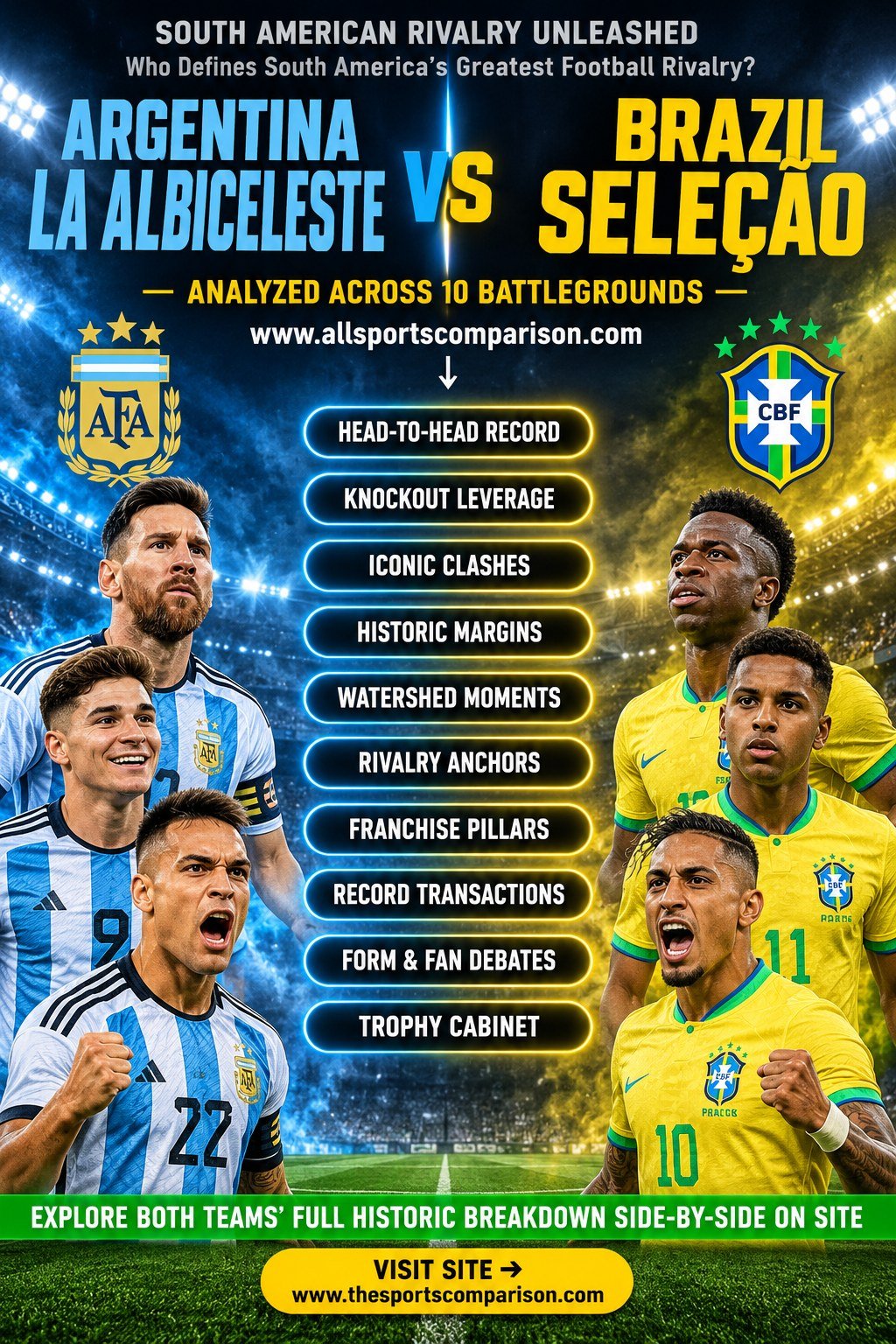
Born on September 20, 1914, at Buenos Aires’ Estadio Gimnasia y Esgrima when Argentina defeated a fledgling Brazilian side 3–0, the Superclásico de las Américas evolved from regional neighborly pride into the ultimate global benchmark of football artistry. Across more than 110 years of border-spanning intensity, contrasting philosophies—Argentina’s gritty, ball-dominant street craft versus Brazil’s expressive, rhythmic improvisation—have turned every qualifier, Copa América battle, and World Cup collision into a geopolitical event watched by hundreds of millions.
All-Time Total Head-to-Head Architecture
| Argentina | Metric | Brazil |
|---|---|---|
| 111 Matches | Total Meetings | 111 Matches |
| 43 Wins | Total Official Wins | 42 Wins |
| 26 Draws | Total Draws / Ties | 26 Draws |
| 167 Goals | Total Goals Scored | 166 Goals |
| 38.7% | Win Percentage (%) | 37.8% |
Tactical Analysis: FIFA’s official ledger illustrates unprecedented parity across more than a century, with Argentina holding a razor-thin one-victory and one-goal advantage after 111 senior A-level internationals. Historically, Brazil dominated mid-century transitions through explosive width and overlapping fullbacks, whereas Argentina frequently neutralized open space using compact midfield diamonds and aggressive counter-pressing. Neither side has ever sustained a double-digit win cushion in the modern era because both teams immediately adapt their defensive block to deny central half-spaces. Every single goal in this fixture carries outsized structural weight, as matches regularly hinge on set-piece organization and single transitional turnovers.
Championship & Knockout Leverage
| Argentina | Stage | Brazil |
|---|---|---|
| 17 Knockout Ties | Tournament Knockout Clashes | 17 Knockout Ties |
| 7 Advances | Elimination Tie Victories | 10 Advances |
| 2 Finals Won | Major Finals Head-to-Head | 3 Finals Won |
| 1 Shootout Win | Extra-Time / Penalty Deciders | 2 Shootout Wins |
Tactical Analysis: While Argentina edges the all-time cumulative tally, Brazil has historically wielded superior knockout leverage in high-stakes tournament elimination brackets. The Seleção captured three consecutive major finals against their rivals between 2004 and 2007 by punishing Argentina’s high defensive line with clinical counter-attacking verticality. However, Argentina flipped the psychological script at the 2021 Copa América Final in Rio de Janeiro, deploying a disciplined low-mid block that starved Brazil’s wingers of isolation angles. In single-elimination settings, Brazil thrives when games stretch vertically after the 60th minute, while Argentina excels when dictating tempo through patient central ball circulation.
Iconic Clashes and Defining Moments
Battered by Brazilian waves for eighty minutes, an injured Diego Maradona spun past three defenders at midfield and threaded a surgical through-ball for Claudio Caniggia to round Cláudio Taffarel.
Ended Brazil’s campaign in shock and immortalized opportunistic counter-attacking efficiency against dominant possession.
Trailing 2–1 deep into stoppage time against a full-strength Argentine side, Adriano chested down a bouncing cross and lashed a left-footed volley into the corner before Brazil prevailed on penalties.
Inflicted one of Argentina’s most painful modern heartbreak losses and launched Brazil’s mid-2000s tournament dynasty.
Powered by Ronaldinho, Kaká, Robinho, and a brace from Adriano, Brazil dismantled José Pékerman’s side with breathtaking one-touch combinations and thunderous long-range strikes in Germany.
Widely regarded as the peak tactical expression of Brazil’s four-attacker system on a global stage.
Rodrigo De Paul launched a forty-yard diagonal pass behind Renan Lodi, allowing Ángel Di María to control cleanly and lift a delicate finish over Ederson inside Rio’s Maracanã.
Delivered Lionel Messi’s first senior international trophy and shattered Brazil’s unbeaten home competitive streak.
Record Blowouts and Historic Margins
Fueled by a Carlos Peucelle hat-trick and a brace from Herminio Masantonio, Argentina overwhelmed Brazil’s defense at Estadio Gasómetro in the highest-scoring blowout ever recorded in the series.
Responding in Rio de Janeiro five years later, Brazil unleashed an unstoppable attacking blitz led by Ademir, Heleno de Freitas, and Zizinho to claim their widest official victory margin over Argentina.
Watershed Disruptions and Game-Changing Flashpoints
After Brazil’s Jair Rosa Pinto suffered a fractured leg in a volatile clash, a pitch invasion halted play for over an hour and sparked a decade-long diplomatic suspension of fixtures.
Prevented the rivals from meeting between 1946 and 1956, fundamentally reshaping South American scheduling.
Outclassed 3–1 by Telê Santana’s fluid midfield, a frustrated 21-year-old Diego Maradona was sent off in the 85th minute for a studs-up lunge on João Batista.
Marked the symbolic torch-passing before Maradona’s 1986 redemption and defined 1980s stylistic contrast.
During an injury stoppage in Turin, Brazilian left-back Branco drank from an Argentine staff bottle, later alleging it contained tranquilizers that left him dizzy throughout the second half.
Became the rivalry’s most notorious gamesmanship legend and prompted strict FIFA touchline hydration protocols.
Brazilian health officials walked onto the Neo Química Arena pitch seven minutes after kickoff to detain four Premier League-based Argentine players over COVID-19 quarantine declarations.
Resulted in the match’s permanent cancellation by FIFA and underscored how political friction permeates the fixture.
Rivalry Anchors and Decisive Performers
Bent entire defensive blocks out of shape under relentless physical marking to create decisive vertical openings.
Delivered hat-trick brilliance in 2012 and orchestrated Argentina’s modern unbeaten streak against their fiercest foes.
Dominated the late 1950s and 1960s with unmatched aerial leap, two-footed finishing, and physical authority.
Served as Brazil’s primary ball-carrying outlet for over a decade, drawing constant tactical fouls in transition.
Franchise Pillars and Historic Icons
| Argentina | Prestige Tier | Brazil |
|---|---|---|
| Lionel Messi (RW / CF) | Franchise Cornerstone | Pelé (CF / AM) |
| Rodrigo De Paul (CM) | Primary Core | Casemiro (CDM) |
| Ángel Di María (RW / LW) | Dynamic Engine | Vinícius Júnior (LW) |
| Diego Maradona (AM) | Immortal Icon | Garrincha (RW) |
| Daniel Passarella (CB) | Golden Era Pillar | Carlos Alberto (RB) |
| Gabriel Batistuta (ST) | Historic Great | Ronaldo Nazário (ST) |
Landmark Roster Transactions
Landmark Call-Up: Integration of Lionel Scaloni’s post-2018 youth core—led by Cristian Romero, Emiliano Martínez, and Enzo Fernández—replacing aging 2014 finalists.
Landmark Departure: International retirement of Ángel Di María following the 2024 Copa América triumph, closing a 145-cap era of big-game wing production.
Strategic roster rejuvenation shifted Argentina’s squad valuation upward while preserving veteran dressing-room leadership. Replacing Di María’s transitional thrust remains the federation’s primary generational transition priority.
Landmark Call-Up: Accelerated senior elevation of Real Madrid forwards Vinícius Júnior, Rodrygo, and teenage prodigy Endrick to spearhead Brazil’s 2026 World Cup cycle.
Landmark Departure: Extended injury absence and declining availability of all-time top scorer Neymar Jr. (79 goals), forcing a structural move away from single-creator dependency.
Transitioning toward explosive European-based wingers elevated Brazil’s counter-attacking ceiling while testing midfield tempo control. Balancing youthful attacking depth with veteran defensive stability defines CBF’s current roster architecture.
Current Form Trajectory and Fan Debates
Tactical Friction: Managing pressing intensity and defensive transitions as key 2022 World Cup midfield starters enter their thirties against high-tempo CONMEBOL opponents.
Core Fan Debate: Should Scaloni gradually transition the starting creative mantle toward younger profiles like Nico Paz and Thiago Almada before 2026?
Tactical Friction: Translating Vinícius Júnior and Rodrygo’s lethal club form into cohesive international scoring against compact low blocks without a natural deep-lying playmaker.
Core Fan Debate: Does Brazil need a traditional physical number nine to unlock crowded penalty boxes, or a fluid false-nine system?
All-Time Trophy Cabinet Showdown
| Argentina | Competition | Brazil |
|---|---|---|
| 3 Titles (1978, 1986, 2022) | FIFA World Cup | 5 Titles (1958, 1962, 1970, 1994, 2002) |
| 16 Titles (Record) | CONMEBOL Copa América | 9 Titles |
| 1 Title (1992) | FIFA Confederations Cup | 4 Titles (Record) |
| 2 Titles (1993, 2022) | CONMEBOL–UEFA Finalissima | 0 Titles |
| 2 Gold Medals (2004, 2008) | Olympic Football Tournament | 2 Gold Medals (2016, 2020) |
| 24 Major Senior Titles | Total Official Senior Honors | 20 Major Senior Titles |
Argentina vs. Brazil remains international football’s purest equilibrium: Brazil owns the global World Cup gold standard with five stars and superior historical knockout advancement, while Argentina commands the continental Copa América record with sixteen crowns and edges both the all-time head-to-head ledger and total senior silverware count. Neither nation can claim unchallenged supremacy because every era of dominance inevitably provokes an equally historic counter-revolution from across the border.
💬